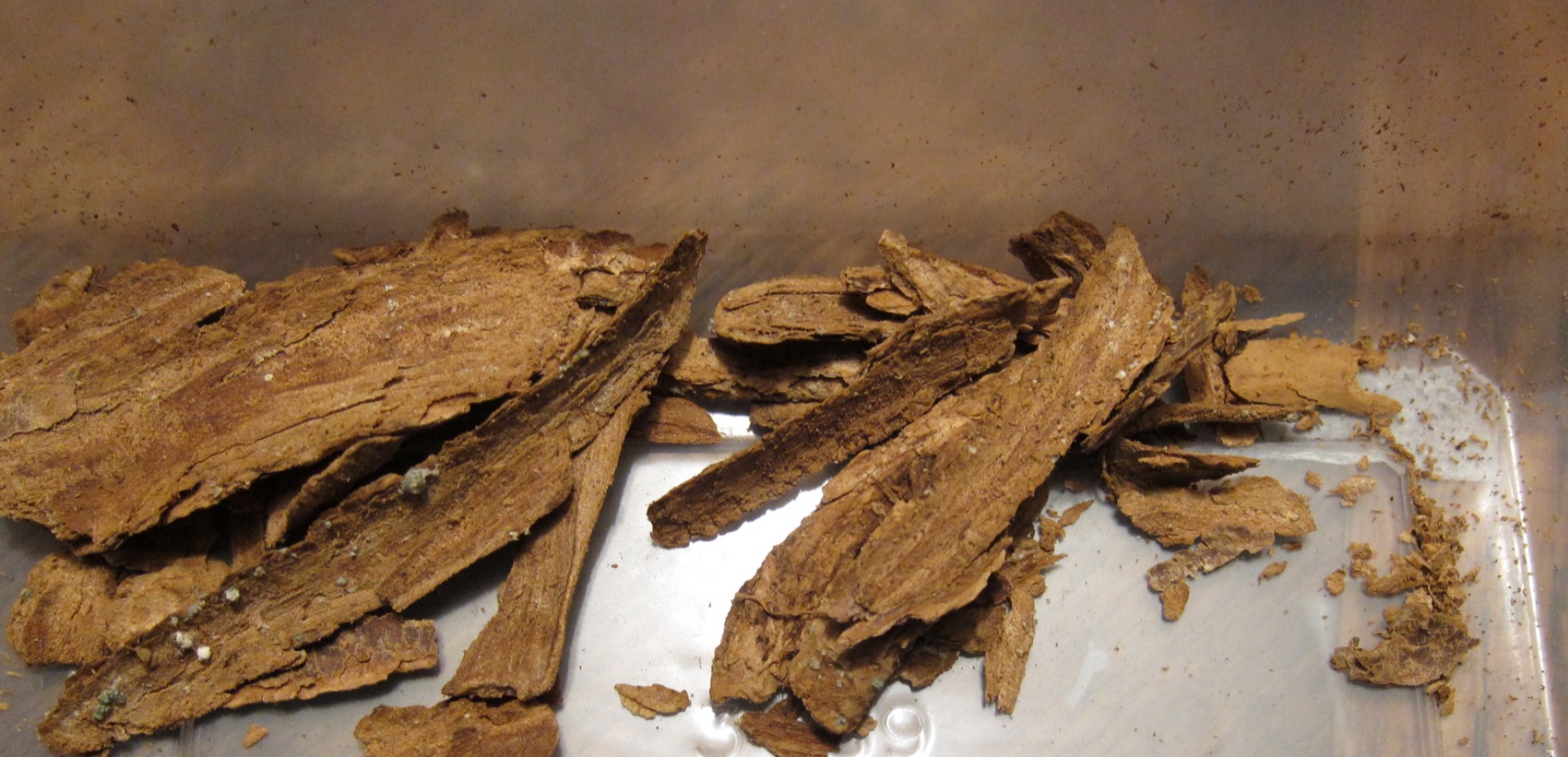
Tabernanthe iboga · root bark
Journey to the root.
Take a walk through the woods and get to know all this plant has to offer.
Scroll
Take a walk through the woods and get to know all this plant has to offer.
For generations, the story of a porcupine who ate the root and turned its belly up has been told as the beginning of iboga.
Drag the porcupine, or use the arrow keys
Long before any of this reached a written record, iboga was being taken as a rite of passage. It belongs to ceremony rather than to treatment: prepared for beforehand, taken in the presence of a community that holds the person through it, and understood as a passage someone comes back from changed. The Bwiti tradition of Gabon and its neighbours is where that practice is best known, and it is still being done.
Ritual bathing before the ceremony begins. The initiate is washed in the river and painted with white kaolin clay, the colour Bwiti gives the dead, so that whoever goes to meet the ancestors arrives already marked as one of them.
Ceremonies are communal, with singing and dancing meant to bind the group together around whoever is taking it. Nobody goes through it alone.
The experience is framed as dying and being born again — a means of meeting the ancestors and coming back changed, rather than a treatment with an outcome.
Iboga makes the body enormously heavy, so dancing under it is hard work. The tradition treats that difficulty as part of the practice, keeping the initiate grounded while the mind travels.
A study of the Gabonese Bwiti way of life: what the word Bwiti actually refers to, the beliefs and practices the Babongo originated and the Mitsogo of southern Gabon later formalised, and how that tradition is read as part of a wider African spiritual renaissance.
Read it if you want to understand iboga as a religion with its own cosmology, initiation and lineage, rather than as a compound that happens to have a history.
Tabernanthe iboga root bark contains a family of indole alkaloids. Ibogaine is the most studied, alongside ibogaline, ibogamine and tabernanthine. The body converts ibogaine into noribogaine, which lasts considerably longer and is thought to carry much of the extended effect.
Whole root bark is not purified ibogaine. It is the plant material itself, with everything that grows alongside the ibogaine still in it.
Root bark runs to roughly 6% total indole alkaloids, of which ibogaine is much the largest share.
Each column is as wide as that alkaloid’s share of the bark is large — ranked, not measured. No assay figure is being claimed; open a column to see where it sits.
An understorey shrub of the Congo Basin forest, in the same family as periwinkle and oleander. Move across the plate to take it apart.
A synapse is the tiny gap nerve cells send their chemical messages across. Almost every drug that changes how a person feels works by interfering somewhere in the loop that carries a message over it — release, cross, catch, recycle. Take the four steps on the diagram in any order, or follow the loop.
Proposed mechanisms Two of the four steps also carry a current hypothesis about ibogaine. All of it is preclinical; none of it is established in human brain injury. Whether any of it is meaningfully engaged at microdose level is unknown, and that open question is where microdosing research now sits.
What makes ibogaine unusual is how many places it interferes at once. Most psychiatric medicines are built to touch one system precisely; ibogaine lands on five, mostly at low micromolar affinity, and no clean mechanistic story has emerged from it. Pick a molecule to see where it sits in the loop and what ibogaine does to it.
Read the current research in the field, from the earliest clinical work through to the trials now being funded.
Tabaac BJ, Carhart-Harris RL, Yung T. Clinical improvement following an integrative iboga microdosing protocol in post-concussive and hypoxic brain injury syndromes: a case series. Front Pharmacol. 2026;17:1840956. doi:10.3389/fphar.2026.1840956
A registry for people already microdosing iboga, so that what happens to them becomes part of the record. It is not open yet.
When registration opens, anyone already microdosing iboga will be able to join and help build the scientific literature on how it affects health and wellbeing. Until then, the tabs below show exactly what taking part will involve: who can join, what is asked, and what is being consented to.
It is an observational registry. It does not supply iboga and it does not assign a protocol. It documents, carefully and over time, what happens to people who are already microdosing.
Before working with iboga, the work of checking it out properly sits with you — what you are taking, who is guiding it, and whether your own health makes it safe.
The beat is the same. The T wave arrives later, so the interval between them stretches. Past a point the rhythm can tip into torsades de pointes, which can be fatal.
Every heartbeat ends with the heart's cells resetting their electrical charge, and a potassium channel called hERG is what lets them do it. Ibogaine blocks that channel. The reset takes longer, the T wave arrives later, and the gap between them — the QT interval — stretches. Stretched far enough, the rhythm can tip into torsades de pointes, a fast disorganised beat that can stop the heart.
That figure comes from clinics giving full flood doses under continuous cardiac monitoring, with an IV line and magnesium to hand. It is not a microdosing figure. The cardiac profile of repeated low doses has not been characterised, which means it is neither reassuring nor alarming — it is unmeasured.
Personal or family history of arrhythmia, long QT, unexplained fainting or sudden cardiac death. A 12-lead ECG where indicated, and cardiology referral for any concerning finding.
Other heart-rhythm drugs, opioids, benzodiazepines and sedatives. So do medicines that change how fast the body clears ibogaine.
Less exposure lowers risk. It does not delete it, and the cardiac profile of repeated low doses is not well characterised.
The plant material itself, harvested from Tabernanthe iboga. Everything that grows alongside the ibogaine is still in it, and the content varies by plant, age and part.
Ibogaine converted from voacangine in Voacanga africana, a faster-growing plant that is not threatened. It takes the pressure off wild iboga, and it is a different material from whole bark.
Without one, "a gram of root bark" is an unknown quantity.
Regulated as such, with export restricted. It is also a living religious practice, not only a plant.
Controlled at the most restrictive tier, which is also the tier that makes research hardest to run.
Unscheduled or differently controlled, and supervised clinical use is permitted in several countries. Check your own jurisdiction before anything else.
Growing demand from Western clinics and research funding is the single largest new pressure on the wild plant.
If you have been invited to take the walk, the path opens here.